A Window into the End of the Dinosaur Age
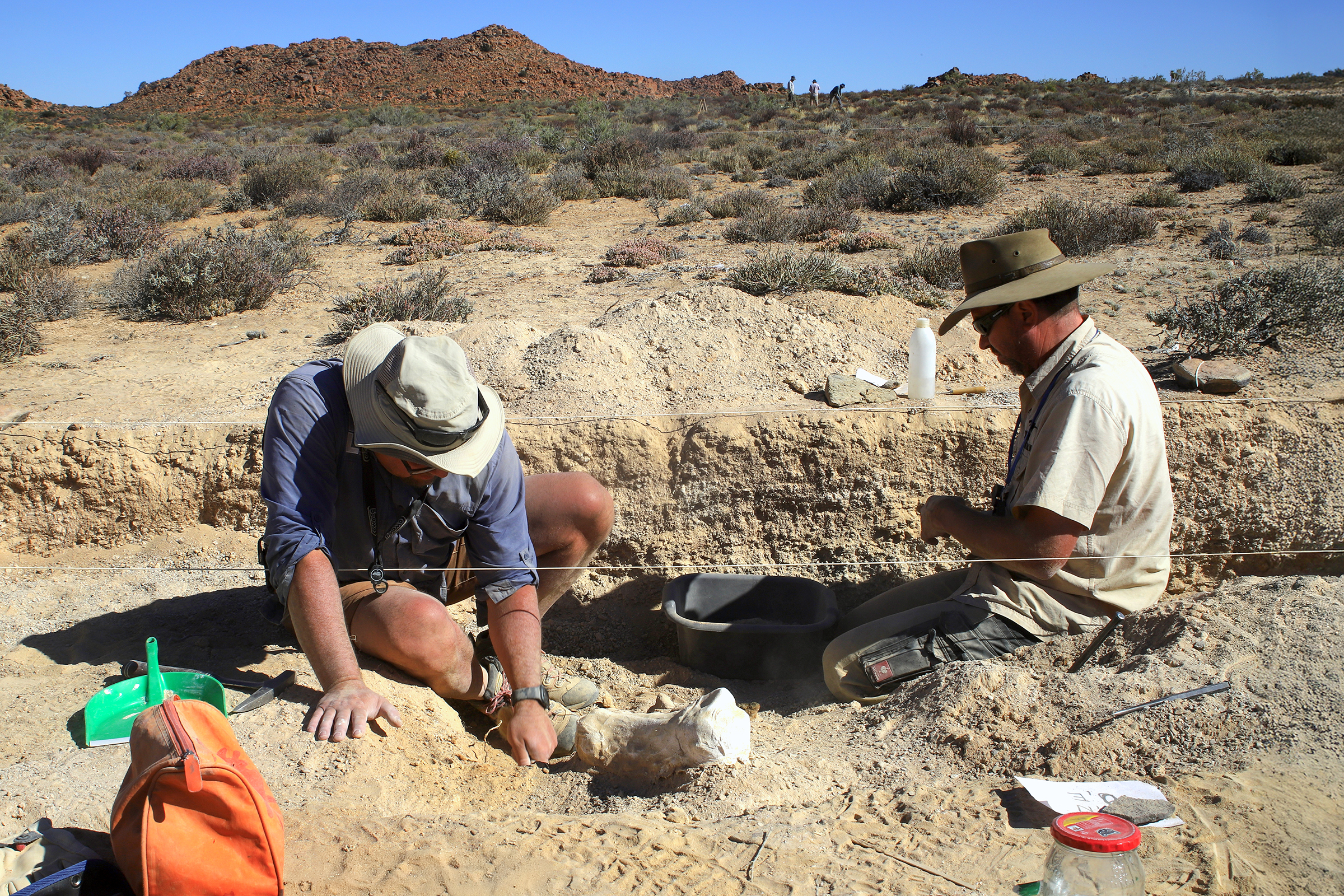
How did the end of the Age of Dinosaurs in Africa impact world history? That’s what researchers aim to uncover during a five-year project of excavation and analysis in the Northern Cape region of South Africa. Their study will explore fossil ecosystems and the biodiversity of sub-Saharan Africa during the Late Cretaceous Period to dramatically expand scientists’ currently limited understanding of this important epoch.
Paleontology (2:30)

The northwestern regions of South Africa, along with the bordering countries of Namibia and Botswana, are dotted with crater lakes that offer a potentially rich—but, until now, largely overlooked—source of sediments and fossils from the Late Cretaceous Period, which began 145 million years ago and ended 66 million years ago.

Though scientists have developed a good understanding of the earlier years of the Dinosaur Age—especially the Jurassic Period, around 200 million years ago—their knowledge of the later Cretaceous Period in the Southern Hemisphere remains minimal, except for some areas of South America.

Thanks to the unusual geological conditions in the Northern Cape, the project to excavate the crater lakes offers a promising opportunity to “fill in the blank spaces on the map” of the Late Cretaceous Period—not only of the dinosaurs themselves but of the larger environment in which they thrived.

Who We’re Supporting

A gift from Griffin Catalyst will support a multipronged project directed by Dr. Peter Makovicky, a Professor of Earth and Environmental Sciences at the University of Minnesota, who previously spent 18 years as Chair of the Department of Geology at the Field Museum in Chicago. Makovicky has searched for fossil records on six of the world’s seven continents.

The support will enable the excavation of the newly discovered Kapkap dinosaur site, expanding excavations to several other crater lake sites nearby, and drilling into these crater lakes to establish their age and to search for evidence about the environments at the end of the Age of Dinosaurs in Africa.

The excavation will take advantage of a special feature of the region, known as kimberlite pipes—geological structures that scientists liken to long fingers of lava in the earth’s mantle, poking up through the crust. This geological feature provides a unique window into the past, allowing paleontologists to capture a fuller and more detailed picture of the Late Cretaceous Period.

Why It Matters

Scientists anticipate that the project will significantly expand our understanding of the Cretaceous fossil record—not only of dinosaurs but of the larger ecology in which they lived. From algae and insects to amphibians and birds, a diversity of fossils are captured in the fine-grain sediment typically found at the margins of the crater lakes.

Researchers also expect to learn more about Southern Hemisphere dinosaurs, which differ significantly from the familiar dinosaurs of the Northern Hemisphere, including the Triceratops and Tyrannosaurus rex.  But the primary goal is not to locate a complete skeleton, nose to tail.  Instead it is to gain a holistic understanding of the era: whether the forests were humid or dry, were dominated by conifers or broadleaf plants, and what kind of insects and mammals might have coexisted with larger creatures.

“It is the whole community picture that we’re trying to reach,” says Makovicky, “the entire diversity in ecology. How is it similar to other Southern Hemisphere floras that we know and how is it different?”

What’s the Impact

Griffin Catalyst’s early philanthropic support will be critical to generating the preliminary data that Makovicky’s team needs to pursue longer-term funding, bridging the gap in traditional funding opportunities.

Because there are currently almost no major dinosaur finds from this age in this region, Makovicky expects the project’s findings to generate a wealth of novel information for the field. “All of this will be new to science,” he observes, and will contribute substantially to our understanding of the end of the Age of Dinosaurs, and the rise of the mammalian age that followed.

IN BRIEF

October 28, 2024
Griffin Catalyst provided a seed gift of $2.5 million to accelerate the efforts of Feng Zhang, a faculty member at the Broad Institute of MIT and Harvard, to develop “programmable therapeutics,” an approach that holds promise for revolutionizing medicine by reprogramming cells to cure a wide range of human diseases.
May 31, 2024
Launched in 2023, the Miami-Dade Innovation Authority leverages the power of competition and innovation to support tech start-ups, scale solutions to local problems, and improve lives. In less than three years, the Authority has taken on challenges as diverse as beach ecology, highway traffic, cargo transportation, waste disposal, airport passenger experience, and, most recently, access to affordable housing and emergency response.
February 12, 2024
The Lincoln Memorial has long been one of America’s most visited monuments and the scene of some of the defining moments of the last century. In time for the 250th anniversary of the country, a new expansion project will transform a massive, long-hidden space beneath the Lincoln Memorial on the National Mall into an immersive museum, exhibition, and theater space, encouraging visitors to explore the story of one of America’s greatest presidents, Abraham Lincoln, and to learn about the nation’s progress toward becoming a more perfect union.
June 10, 2026
Griffin Catalyst is supporting scientific innovation through a novel approach known as Focused Research Organizations (FROs). These initiatives take on high-risk, high-potential challenges in science that academic research groups and for-profit companies aren’t well-suited to solving—with a well-defined goal and a time-limited opportunity to make progress. Griffin’s $20 million in support of this model has helped propel two initial FROs—Parallel Squared Technology Institute and Forest Neurotech—to advance work with the potential to address a range of neurological and age-related diseases. Inspired in part by the promise of this approach, the National Science Foundation recently announced a new Tech Labs Initiative,
May 12, 2026
For the first time in recorded history, in recent years, avian flu reached Antarctica, threatening animals in an already fragile ecosystem. Griffin Catalyst responded proactively to this potential crisis—which, gone unchecked, had the potential to devastate Antarctica’s penguin, seal, and seabird populations, with global consequences. By supporting a new scientific monitoring and surveillance effort led by researchers at Cornell University, Griffin Catalyst helped scientists understand the nature and spread of the new virus and what immunity looks like for previously infected animals, with important implications for mitigation strategies and poultry, fishing, and tourism policies that may reduce its spread.
November 12, 2025
The health of one of America’s greatest and best-known watersheds, the Florida Everglades, has been under increasing threat in recent years from agricultural needs and the development demands of the fast-growing population of South Florida. Griffin Catalyst’s support for The Everglades Foundation—a three-decade-old nonprofit organization that helps to protect and restore the immense but fragile ecosystem—is allowing the group to expand its scientific team and resources in order to provide data-driven policy recommendations to the state and federal agencies that are leading the Everglades’ multiyear, multibillion-dollar restoration effort.
September 4, 2025
A three-year gift to the University of Chicago’s Education Lab has brought an innovative, high-dosage, math tutoring initiative to middle schools in Miami-Dade County in an effort to support and accelerate student learning in the wake of the COVID-19 pandemic. Initial results from the program, which started in spring 2024, are promising, suggesting that this approach can help tackle learning loss and enable students to catch up to grade level.
April 17, 2025
Griffin Catalyst is proud to partner with the nonprofit American History Unbound. The collaboration will present dramatic multimedia storytelling about World War I and World War II to audiences in New York and Miami, and nationwide through a documentary being filmed for broadcast on public television later this year, to coincide with Veterans Day. The unique combination of narration and imagery from renowned historian John Monsky, accompanied by music from Broadway stars and the Orchestra of St. Luke’s, brings to life in new ways two of the most pivotal events in the 20th century.
August 30, 2024
Since 2023, Griffin Catalyst has made transformative gifts to major health care institutions in Miami. Taken together, the support, totaling $150 million, represents an investment in the future of medical care and research in South Florida, allowing these institutions to recruit some of the best health-care professionals in the country, and propelling the region’s future.