Fostering Innovation to Tackle Miami-Dade's Most Pressing Challenges
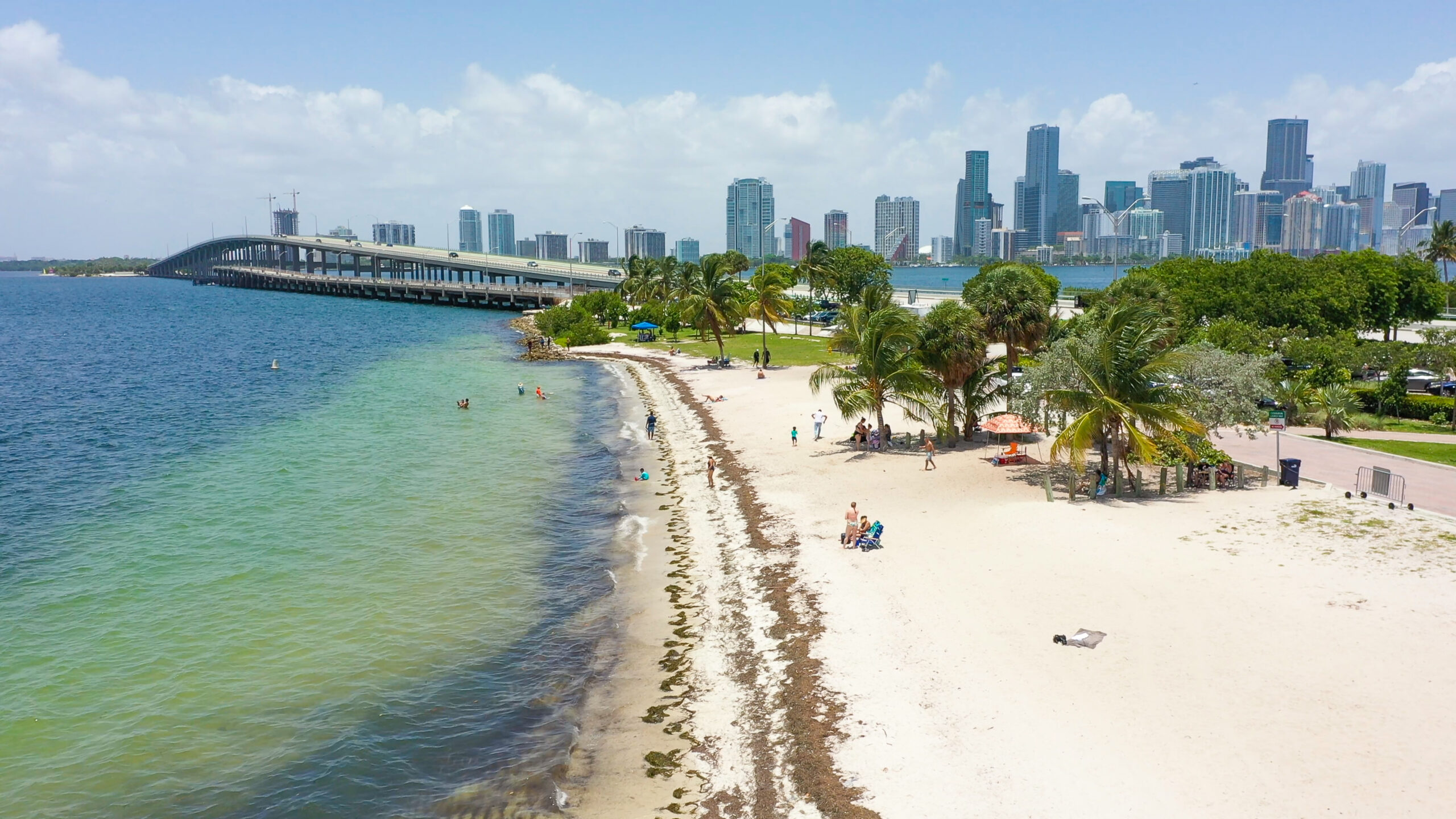
Launched in 2023, the Miami-Dade Innovation Authority leverages the power of competition and innovation to support tech start-ups, scale solutions to local problems, and improve lives. In less than three years, the Authority has taken on challenges as diverse as beach ecology, highway traffic, cargo transportation, waste disposal, airport passenger experience, and, most recently, access to affordable housing and emergency response.
Photo Credit: Miami-Dade Innovation Authority
The Miami-Dade Innovation Authority, founded in 2023, is developing public-private partnerships to bring imaginative yet practical solutions to urban challenges in one of America's fastest growing cities, including sargassum clean-up initiatives in Virginia Key Beach (above) and other public waterfront areas.

Focused on tackling pressing local problems and improving the efficiency and quality of public services, the Miami-Dade Innovation Authority (MDIA) is a public-private partnership that identifies and invests in early- to growth-stage tech companies building scalable solutions in the region.

With $9 million in support from Griffin Catalyst, the Knight Foundation, and Miami-Dade County, MDIA has launched seven “public challenges,” each focused on solving a specific citywide problem. The Authority selects one or more of the most promising solutions from entrants worldwide, tests those solutions over a three- to six-month period, then fast-tracks successful innovations to scale in the Miami-Dade region.

Who We’re Supporting

Griffin Catalyst helped to launch the Miami-Dade Innovation Authority in 2023. Inspired by the Israel Innovation Authority—which has helped Israel become one of the leading centers of tech innovation in the world—MDIA is focused on strengthening the relationship between Miami-Dade County and tech companies with solutions to regional challenges. To this end, MDIA’s “public challenges” provide $100,000 in funding to companies—both in Florida and around the world—whose winning approaches are innovative, practical and cost-efficient.

Under the leadership of President and CEO Leigh-Ann Buchanan, MDIA began its Public Innovation Challenges with an open call for innovative and sustainable strategies to address one of the area’s most urgent problems: how to repurpose sargassum, the floating mats of seaweed that wash up on Miami’s beaches during the summer.

Building on this experience, MDIA launched its second and third challenges, to improve the passenger experience at Miami International Airport and to enhance cargo visibility at PortMiami, two of Florida’s leading engines of economic development. It then moved on to three equally crucial areas of urban life, with challenges to improve the removal and diversion of waste in the region; leverage sensors, predictive analytics, AI and machine learning, and other technologies to enhance traffic visibility and management of highway and road traffic; and streamline the ability of ordinary citizens to apply and qualify for affordable housing. Its seventh and current challenge, developed in partnership with the Miami-Dade County Department of Emergency Management, Big City Emergency Managers, and Florida International University’s Academy for International Disaster Preparedness, seeks to expand Miami-Dade County’s capacity to respond to emergencies, using breakthrough technology to strengthen emergency management, and predictive analytics to improve real-time communication for rapid response.

Why It Matters

Beyond their direct value in improving the quality and efficiency of vital urban services, MDIA’s public challenges are furthering the goal of strengthening Miami-Dade County’s already growing tech community. Winners partner with the County to test their solutions, looking to determine the likelihood of success within three to six months. For approaches that appear promising, MDIA assists in fast-tracking projects through the County procurement process to ensure the technology is quickly scaled and implemented.

MDIA also serves as a beacon for companies globally that might otherwise have not had Miami on their radar, and partners with tech-talent pipeline efforts at Miami’s schools, universities, and other institutions to create additional pathways for emerging tech jobs.

Unlike traditional start-up accelerators, focused mostly on the bottom line, MDIA seeks to maximize both profit and impact—both on pressing local challenges and on job creation in the region

What’s the Impact

Within four months of starting operations in 2023, MDIA, with support from The Nature Conservancy, had launched its first Public Innovation Challenge, calling for tech companies to propose creative approaches to repurposing sargassum. In 2022 alone, Miami-Dade County had spent $4.2 million in sargassum collection, removal, and clean-up efforts.

By the start of 2024, the Authority had selected four winners and awarded grants of $100,000 each for the development of sustainable solutions. Florida-based Algas Organics proposed turning sargassum into fertilizer for farmers and Boston-based CarbonWave, PBC pitched upcycling the seaweed into an agricultural yield enhancer, while Miami-based Chemergy explored green hydrogen solutions and United Kingdom-based XMET Ltd. converted seaweed into polymers.

“This challenge is an example of our continued investment in having a future-ready infrastructure to work more efficiently, stay ahead globally, create jobs locally, and serve our customers better,” said Miami-Dade County Mayor Daniella Levine Cava.

MDIA has since launched five more initiatives, resulting in a host of winning tech solutions to urban challenges, from mobile-phone apps to ease passenger navigation through Miami International Airport, to an AI-powered platform that turns existing closed-circuit TV systems in cargo ports into an intelligent surveillance network, to cloud-based software, using machine learning, that can analyze roadway sensor data to identify traffic backups as they occur.

Leveraging competition to drive discovery and progress, the Miami-Dade Innovation Authority has become a national leader in identifying and supporting innovative, scalable solutions to some of the most pressing urban and environmental problems in cities today.

In Brief

December 27, 2023
The success of Operation Warp Speed in 2020, which brought forth an effective COVID-19 vaccine in less than twelve months, was not only a scientific breakthrough but also a demonstration of the power of an approach called an advanced market commitment (AMC). By creating a demand so that pharmaceutical companies could invest in production prior to proving the efficacies of vaccines, this successful approach accelerated time to market and highlighted the opportunity for a class of similar “market-shaping tools” to accelerate progress. To expand this approach, Griffin Catalyst and Schmidt Futures have partnered with the University of Chicago to launch
October 28, 2024
Griffin Catalyst provided a seed gift of $2.5 million to accelerate the efforts of Feng Zhang, a faculty member at the Broad Institute of MIT and Harvard, to develop “programmable therapeutics,” an approach that holds promise for revolutionizing medicine by reprogramming cells to cure a wide range of human diseases.
October 30, 2023
Griffin Catalyst is funding the construction and programming of 50 soccer mini-pitches in underserved communities across Florida’s Miami-Dade County. The $5 million initiative, carried out with The Children’s Trust, the U.S. Soccer Foundation, and Miami-Dade County, will increase access to the game for young people county-wide, impacting over 30,000 local children over the next seven years, and help build community in dozens of neighborhoods.
June 10, 2026
Griffin Catalyst is supporting scientific innovation through a novel approach known as Focused Research Organizations (FROs). These initiatives take on high-risk, high-potential challenges in science that academic research groups and for-profit companies aren’t well-suited to solving—with a well-defined goal and a time-limited opportunity to make progress. Griffin’s $20 million in support of this model has helped propel two initial FROs—Parallel Squared Technology Institute and Forest Neurotech—to advance work with the potential to address a range of neurological and age-related diseases. Inspired in part by the promise of this approach, the National Science Foundation recently announced a new Tech Labs Initiative,
May 12, 2026
For the first time in recorded history, in recent years, avian flu reached Antarctica, threatening animals in an already fragile ecosystem. Griffin Catalyst responded proactively to this potential crisis—which, gone unchecked, had the potential to devastate Antarctica’s penguin, seal, and seabird populations, with global consequences. By supporting a new scientific monitoring and surveillance effort led by researchers at Cornell University, Griffin Catalyst helped scientists understand the nature and spread of the new virus and what immunity looks like for previously infected animals, with important implications for mitigation strategies and poultry, fishing, and tourism policies that may reduce its spread.
November 12, 2025
The health of one of America’s greatest and best-known watersheds, the Florida Everglades, has been under increasing threat in recent years from agricultural needs and the development demands of the fast-growing population of South Florida. Griffin Catalyst’s support for The Everglades Foundation—a three-decade-old nonprofit organization that helps to protect and restore the immense but fragile ecosystem—is allowing the group to expand its scientific team and resources in order to provide data-driven policy recommendations to the state and federal agencies that are leading the Everglades’ multiyear, multibillion-dollar restoration effort.
September 4, 2025
A three-year gift to the University of Chicago’s Education Lab has brought an innovative, high-dosage, math tutoring initiative to middle schools in Miami-Dade County in an effort to support and accelerate student learning in the wake of the COVID-19 pandemic. Initial results from the program, which started in spring 2024, are promising, suggesting that this approach can help tackle learning loss and enable students to catch up to grade level.
June 17, 2025
How did the end of the Age of Dinosaurs in Africa impact world history? That’s what researchers aim to uncover during a five-year project of excavation and analysis in the Northern Cape region of South Africa. Their study will explore fossil ecosystems and the biodiversity of sub-Saharan Africa during the Late Cretaceous Period to dramatically expand scientists’ currently limited understanding of this important epoch.
April 17, 2025
Griffin Catalyst is proud to partner with the nonprofit American History Unbound. The collaboration will present dramatic multimedia storytelling about World War I and World War II to audiences in New York and Miami, and nationwide through a documentary being filmed for broadcast on public television later this year, to coincide with Veterans Day. The unique combination of narration and imagery from renowned historian John Monsky, accompanied by music from Broadway stars and the Orchestra of St. Luke’s, brings to life in new ways two of the most pivotal events in the 20th century.