Increasing Public Engagement with World-Class Art
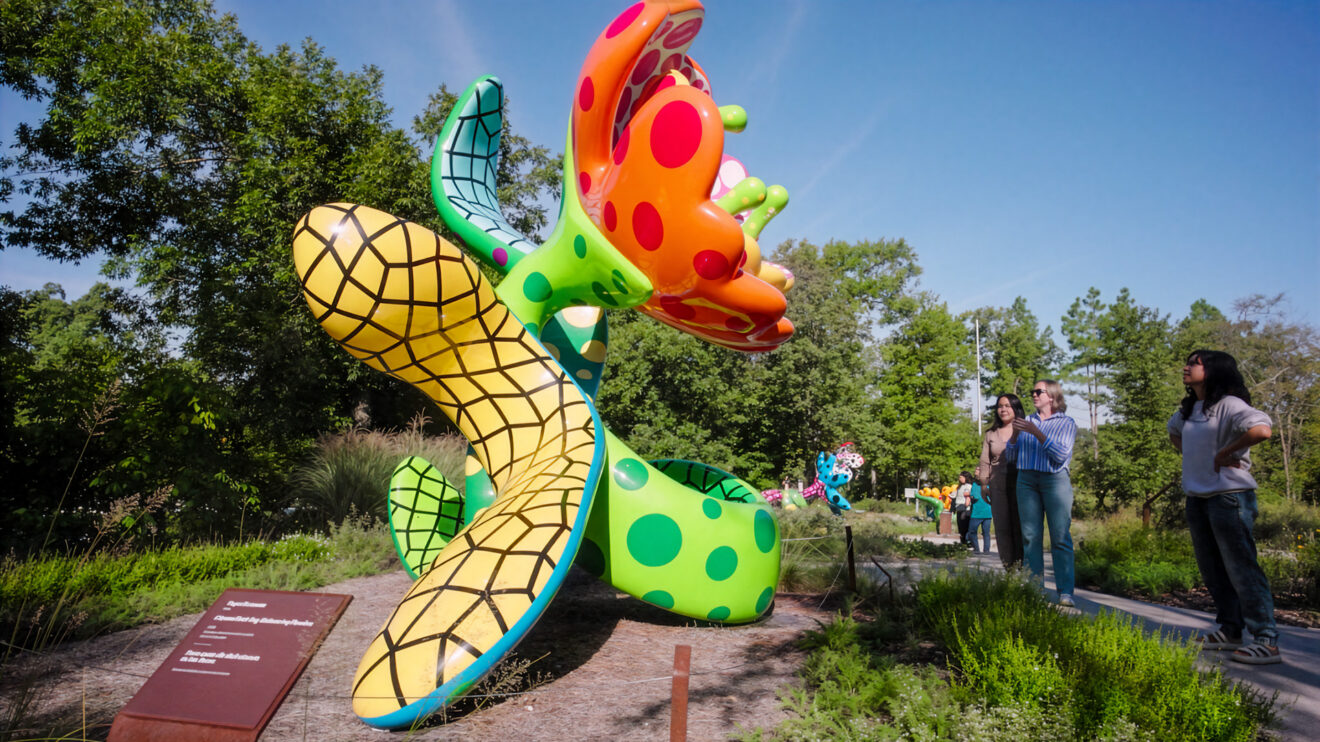
Though it is widely recognized that exposure to world-class art can enhance and uplift people of all backgrounds, some members of the public may be hesitant to enter the doors of art museums and galleries.
One promising response to this challenge is to bring art exhibitions out of museums and to the places where people work, play, and live, through outdoor installations in easily accessible public spaces where visitors can engage with world-class art at no cost, and as part of their daily lives. To make this approach a reality, Griffin Catalyst is helping to support efforts by major art institutions in the United States and the United Kingdom to increase public access to art.
Who We’re Supporting
In Arkansas, Griffin Catalyst is supporting a project of the Crystal Bridges Museum of American Art, an innovative cultural complex located on a 134-acre campus in the Ozark Mountains. Opened in 2011, the museum, which is free of charge to the public, features a landmark glass-and-wood main building designed by the renowned architect Moshe Safdie, along with extensive landscaped grounds running throughout the Ozark forest, laced with five miles of walking and biking trails.
In recent years, the Museum has installed major sculptures along its outdoor trail system, allowing residents and visitors to roam its forests, ponds, and gardens to discover and engage with artwork. “We have amazing sculpture all over,” notes Olivia Walton, chairperson of Crystal Bridges, “because art needs to be part of everyday life.” This year’s major installation, supported by Griffin Catalyst, is a series of large-scale flower sculptures by the world-renowned artist Yayoi Kusama, which has proved especially popular with families and children. “It is important to bring art outdoors,” Walton says, “because the truth is not everybody is comfortable coming into an art museum, so you’ve got to meet people where they are.”
In London, Griffin Catalyst is supporting a parallel project by the Serpentine Gallery, a museum of contemporary art located in Kensington Gardens, one of the city’s highest-trafficked and best-known public spaces. To engage park visitors with the Serpentine and its exhibitions, the Gallery is curating a revolving series of outdoor sculpture installations, including, most recently, two large-scale pieces by the Italian artist Giuseppe Penone, a major figure of the Arte Povera movement, which accompanied a related exhibition at the museum. The monumental sculptures, cast in bronze, resemble trees: one a tree being struck by lightning, and the other a pair of trees carrying heavy boulders within their branches. “At Serpentine, people enjoy the spaces in so many different ways,” observes Bettina Korek, the museum’s CEO, “and that is what we want, for people to embrace it as their own.”
More recent Griffin Catalyst support includes gifts to the Public Art Fund, the New York-based cultural organization that is widely considered the nation’s leader in bringing dynamic contemporary art to the public in urban environments. Their current slate of installations will be bringing a group of noted international artists to some of the city’s most celebrated and heavily used public spaces, including works by Woody de Othello in Brooklyn Bridge Park, Genesis Belanger in City Hall Park, and Camille Henrot in Central Park.
In Miami, the impact of the extraordinary urban transformation known as The Underline—a ten-mile-long linear park running beneath the elevated Metrorail—is being amplified by an “Art Trail” whose nine installations, spanning more than two-and-a-half miles, showcase beloved local, national, and international artists and celebrates Miami’s diverse community. The projects, both inspiring and functional, include traditional and interactive sculptures, an artist-designed ping-pong table, communal benches, an interactive bookshelf, temporary murals, and a sculpture garden for children.
Why It Matters
The efforts of all four organizations to extend the impact of art into the public realm—or, in the words of Bettina Korek, “to break the barriers of the doors of the gallery with public art”—works not only to expand the reach of culture beyond traditional audiences but to enlarge the human spirit. “Bringing art into public space helps us step into perspectives beyond our own,” Korek adds. “Our pace stops. We slow down. Art in public space can create opportunities for surprise.”
“Art is a signal of what we value as a society,” Walton adds. “It’s a way of saying, we value creativity. We value diversity of ideas, we value fresh thinking, and we value imagination. If you have imagination, you have hope.”
“The Underline art program invites both locals and tourists to explore and engage with art in a personal and open way,” adds Debi Wechsler, Chair of The Underline’s Art Advisory Council, “making it accessible for everyone to experience up close.”
What’s the Impact
Each of the four initiatives is, or soon will be, impacting the public in major and positive ways. The Underline’s evolving art initiative offers a significant addition to Miami’s already rich cultural landscape, where both Miamians and visitors alike can, in the words of The Underline, “play the park like an instrument, muscle up in gyms, quiet down in meditation, and enjoy street theater, concerts, poetry battles, choral sonatas, and many more site-specific community-building interventions.”
Both the Serpentine Gallery and Crystal Bridges have reported dramatically increased engagement with the public thanks to their public art and access initiatives.
Kensington Gardens and the adjoining Hyde Park welcomes about thirteen million visitors a year, and thanks to its outdoor sculpture program, the Serpentine has enjoyed success in bringing a growing number of those park visitors into its orbit. “We’ve seen so many people in beautiful weather having a picnic in the park,” Bettina Korek observes, “and seeing the Penone ‘trees’ and being engaged to go into the Gallery, and for us, free admission is a core part of our mission.” Indeed, the Serpentine reports that about 65 percent of its audiences engage with the Gallery’s public art program.
For Crystal Bridges, the impact has been similarly positive, with tens of thousands of visitors, including more than 80,000 children a year—enjoying artwork they might otherwise never get a chance to see. “Perhaps you come across a sculpture when you’re walking your dog on a trail around the museum grounds, and maybe that sparks the idea to come inside our walls of our core campus and learn about our program,” Olivia Walton observes. “For people who don’t think, ‘hey, I’m an art expert,’ at least they can walk by something and it can spark imagination, spark connections, spark some kind of understanding, perhaps spark a dialogue.”