Educating America’s Future Problem-Solvers

1. Introduction
The ability to harness the power of data is of great importance to our country’s competitiveness and future success.
Introduction
One evening in late 2018, Steven D. Levitt found himself in the midst of a familiar and frustrating ritual: helping one of his children with high school math homework. As the father of four teenagers, Levitt—the celebrated University of Chicago economics professor who co-authored the bestseller “Freakonomics”—had been through the dispiriting routine before. This time his daughter Sophie, a sophomore, was being asked to solve an algebra problem: “Rationalize the denominator in the equation: 3 over the square root of X minus 7.”
Levitt himself loved math and used it all the time in his work. But he was convinced that the math curriculum Sophie was being taught, almost identical to the syllabus his own teachers had used decades before—and one that had been originally devised many decades before that—needed to be significantly updated to include more relevant kinds of mathematics, statistics, and data science.

If you walk into a high school math class, you are essentially walking into the same courses that were taught in the 1960s or ’70s, when there were no computers, when there was no data.
An Urgent Need
There are few abilities more valuable in the modern world, many believe, than what Steven Levitt calls “data fluency.” To Levitt, this means a basic comfort with data, an understanding of the difference between correlation and causality, the capacity to evaluate claims that others make with data and, ideally, even the ability to take what Levitt called “a pile of data” and make sense out of it.
The need for this kind of literacy is urgent—and growing more so every year. Even as data-oriented careers increase by 35% annually in the United States, nearly two-thirds of American companies struggle to find data-literate employees. In recent years, data literacy has become crucial to our ability to make intelligent decisions about a growing number of public policies and consumer and business decisions. Even cars, Levitt points out, are now essentially sources of data, requiring data fluency among auto mechanics.
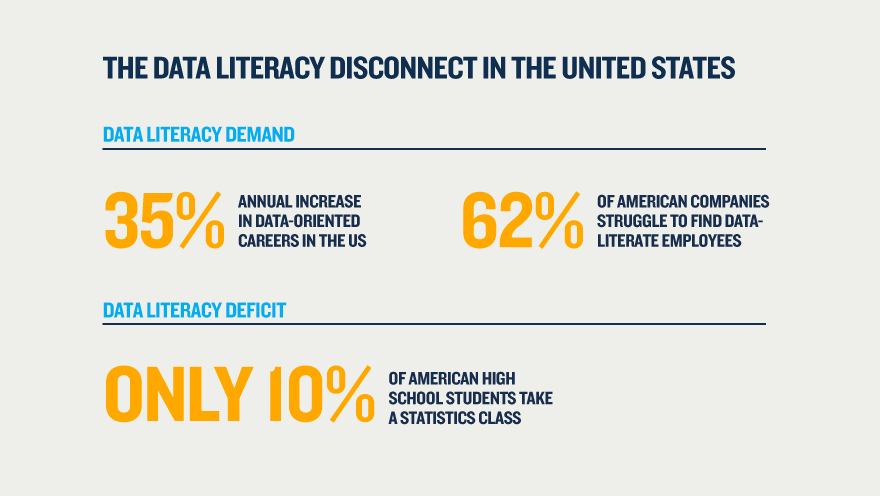
At the time of Levitt’s encounter with his daughter’s curriculum in 2018, however, most students were barely being exposed to data science at all. In 2018, only 10% of American high school students had taken a statistics class, and the courses they did take are largely theoretical rather than ones requiring students to delve deeply into working with data.
The widespread lack, Levitt argued, was becoming a threat to global competitiveness, noting that “there are other countries that are doing this much better than the United States.” A greater focus on data in the high school math curriculum, he believed, would enhance the student experience as well, as data science lends itself easily to a wide range of academic and real-world interests in a way tradition high-school math often does not.
“The beauty of data science is it applies mathematical scientific tools in whatever context is of interest to the student. You can meet students exactly where they are. And that is something you can't do easily with almost any of the other math subjects that we teach in high school.”
In 2019, Levitt devoted his popular “Freakonomics” podcast to data science, arguing for a more central place for the subject in the high school curriculum. “The podcast came out, and it went viral, and we had literally hundreds of teachers, school leaders, charter school networks calling us,” recalls Levitt’s colleague Zarek Drozda. “The governor of Mississippi, at one point, called us, trying to see how they could bring data science to their state.”
Data Science 4 Everyone
“Data has been called the “new oil”…the fuel behind so many emerging technologies and artificial intelligence and blockchain and also is, increasingly, an aspect of every career, every sector.”
Levitt is hardly alone in his conviction about the importance of high school data-science courses. “There was an enormous thirst for this,” he observes, “and it’s a thirst that pervades the universities, the parents, the students—even the math teachers, I believe.” At least a dozen groups around the country have been working on the same problem for years, but until recently their disparate efforts had made limited headway.
The solution has been to combine forces through a new national coalition, Data Science 4 Everyone. Based at the University of Chicago, the coalition works toward the widespread adoption of data science in K-12 curricula, aiming to make data literacy a graduation requirement for every student in the country.
To help bring their vision to reality, Griffin Catalyst, in partnership with Schmidt Futures, the Siegel Family Endowment, and the Valhalla Foundation, announced their support in June 2021. Griffin Catalyst’s support allowed the coalition to become a sustainable organization with full-time staff dedicated to advancing this work nationally and enabled pilot programs to support new data science programs in school districts around the country.
Since then, Data Science 4 Everyone has tracked the expansion of data science education through a continuous review of course catalogs, data science pilot courses, teacher professional development, and the adoption of data science learning standards and curricula in all fifty states.
Thanks in part to the coalition’s initiatives—extending by now to 1,000 schools in 157 districts across the country—the United States has seen have a dramatic improvement in data science education. In the 2024-25 school year, more than 70,000 students were enrolled in a specialized data science course, or one that included substantial data science content. Meanwhile, 3,091 K–12 educators across the United States had received a total of more 23,000 hours of professional development in data science in the past year alone.

When you think of technical fields, like computer science, creativity is not the first thing that you associate with it, but I feel like data science allowed me to really express my own creativity.
Championing Critical Thinking
Data science and data literacy are powerful tools for the 21st century, but there is something just as fundamental—if not more—that students will need to solve the most challenging problems of the future: the ability to think critically.
Griffin Catalyst recently joined the Hewlett Foundation, John D. and Catherine T. MacArthur Foundation, Gordon and Betty Moore Foundation, and Rockefeller Foundation to provide pilot funding to establish a partnership with University of California, Berkeley professor and Physics Nobel Laureate Saul Perlmutter and Nobel Prize Outreach to design, implement, and evaluate a new curriculum for high schoolers called “Scientific Thinking for All: A Toolkit.”
The partnership’s pilot project will develop, disseminate, and test a new scientific critical thinking course—expanding the teaching tools of science education to help students around the world evaluate evidence, question their analyses, think probabilistically, and solve problems patiently, optimistically, and iteratively. As it evolves, the pilot aims to expand globally, reaching educators and students in countries around the world.